

This isn’t a tutorial. It’s not a brag post.
I’m not here to tell anyone “how to win,” and I’m definitely not trying to make you chase the same moment.
I’m writing this because too many people only remember the screenshot—the jackpot frame—while the real danger usually hides in the minutes after the hit.
We recently reviewed a real play log from Super Ace Deluxe: 1,131 rounds in a single day. The player finished up big, yes. But if you’ve spent any time in high-volatility games, you already know the truth:
Winning doesn’t automatically mean you were safe.
And it doesn’t mean you “figured something out.”
It’s in the record:
Bet: 500
Payout: 557,900
Net: +557,400
I understand exactly what that feels like. It’s not just money—it’s that rush where it feels like the world finally nodded at you.
And honestly? The most dangerous part often isn’t the hit itself.
It’s the story your brain starts writing right after:
“It’s hot today.”
“I’m in sync.”
“I found the rhythm.”
“Just a little more.”
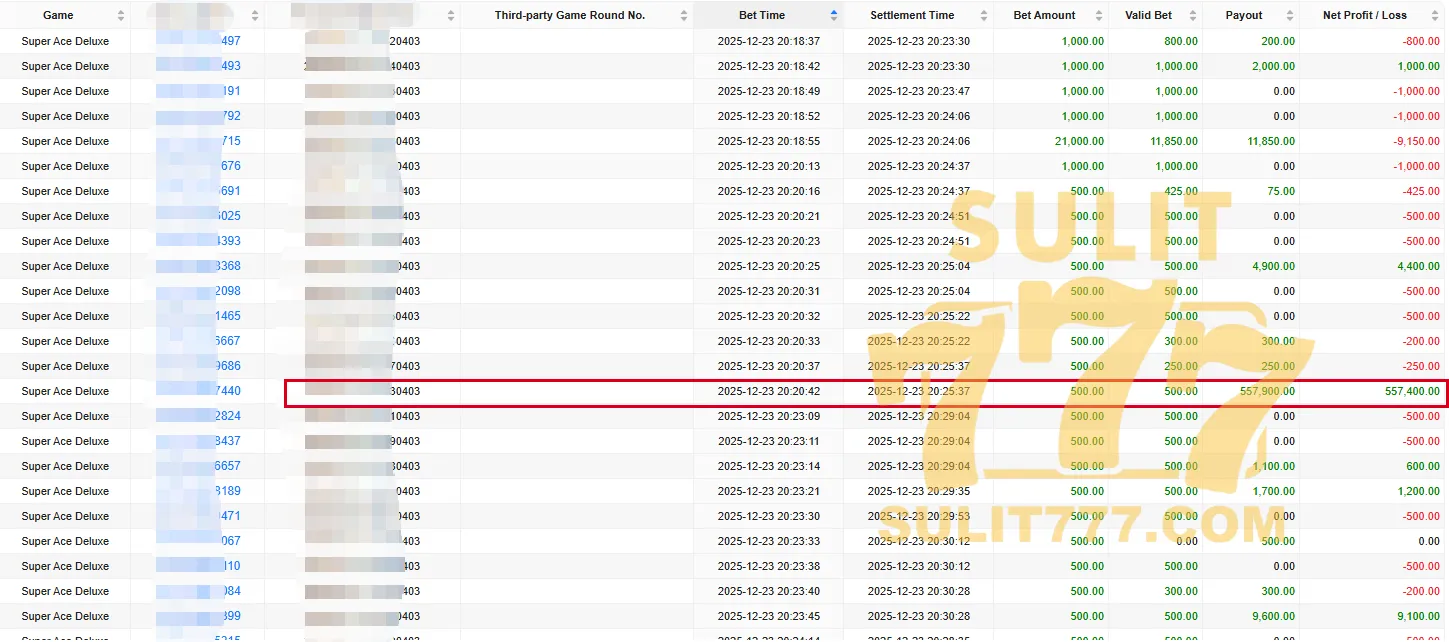
When we split the log, it clearly shows two separate sessions, with a long break in between.
In the first session, the player stayed more often at 500 / 1000, with a slower rhythm—more like watching the screen and waiting for moments.
And after the huge hit, they didn’t instantly slow down. They extended the session and pushed into a higher-stake stretch.
That’s not “stupid.” It’s human.
Because after a big win, your brain naturally whispers:
“Today is open.”
“My timing is right.”
“Let me press while it’s working.”
Later, the player came back and mostly used 100 / 200, but at a much faster tempo—rapid-fire clicking.
On the surface, low stakes looks safer. Sometimes it is.
But if you’ve been there, you might recognize another reality:
You’re not always playing low stakes because you’re calm.
Sometimes you’re playing low stakes because you can’t stop thinking about the earlier hit—but you don’t want to burn big money immediately.
Here’s the pattern we care about most, and the reason I’m sharing this:
Most of the time, the player was steady and “locked in.”
But in certain moments, they would suddenly take a heavy shot.
And those heavy shots often aren’t “strategy.”
They’re emotion.
There was a very telling moment near the end of Session A: a sudden large bet (21,000) that turned into the biggest single loss in the record.
That “near-the-end heavy shot” is something we’ve seen again and again.
In that moment, most people aren’t thinking about math. They’re thinking:
“Let me pull it back before I stop.”
“One last big try.”
“If I hit once more, I’ll leave.”
If this sounds familiar, please don’t feel ashamed.
This isn’t a “you problem.” It’s one of the most common traps in high-volatility play:
You’re not always fighting the game. Sometimes you’re fighting the urge to write a prettier ending.
Because this rhythm is familiar to a lot of players:
After a big win, it becomes harder to stop
You leave… then come back to “cool down,” but you’re still chasing a feeling
You’re steady for long stretches… then spike suddenly
The spikes happen most often in the final minutes—right before you plan to quit
This isn’t morality. It’s not intelligence.
It’s simply a warning that control can quietly transfer to emotion at certain points.
From an operator’s perspective, we don’t fear a player losing a normal amount.
What we fear is a player making decisions while they’re “up there” emotionally—because in that state you tend to:
Underestimate risk
Overestimate how repeatable a lucky moment is
Turn randomness into a “pattern” in your head
So here’s a simple, practical self-check. No preaching. No drama.
I often increase stakes in the last 5–10 minutes
I frequently tell myself “just one more round”
After a big win, I stay longer instead of leaving
I return mainly because I can’t stop replaying the earlier hit
That 15-minute pause isn’t “discipline talk.”
It’s because when you’re emotionally charged, you’re simply more likely to do something you’ll regret later.
Yes, that 500 → 557,900 moment is insane. I get it.
But what I hope you remember is this:
The thing that hurts you most often isn’t the hit.
It’s what you tell yourself after the hit.

Nagbabahagi kami ng mga pinakatotoong case at gumagawa ng pinakatotoong pagsusuri ng pagtaya para sa mga gustong mag-refer at matuto. Hindi lang ito puwedeng i-apply sa Sulit777—puwede rin ito sa iba pang online casino

SULIT777 is the leading online gaming news portal in the Philippines. We provide the latest SULIT777 app downloads, secure login links, and verified casino PH reviews. Your trusted guide to safe gaming
© 2026 SULIT777.COM – All Rights Reserved. Disclaimer: Gambling involves risk. Please play responsibly. Strictly for 21+ users only.